
Research program
Innovation and Productivity Strategies
IPS is the research program of the institute. It develops models that leaders can deploy across the enterprise, along the full stream from research ideas to customer experiences in goods and services.
Composite model
Four domains, working together
Used together, Strategy, Process, Organization, and Tools explain more than models with fewer drivers, because each domain reinforces the others. The pattern varies from research laboratories to services. Practices are measured so teams can adopt and adapt them.
Figure
The composite model
- Strategy
- Formulate, implement, and adapt goals with the people responsible for doing the work.
- Process
- Deploy disciplined but flexible methods to design and produce customer offerings.
- Organization
- Bring diverse specialists together early, making product decisions throughout the development cycle.
- Tools/Technologies
- Extend human capability for design and production, using tools to communicate and collaborate.
Cross-functional teams give specialists room to form new product concepts. Process discipline then guides that work toward customer requirements at a manageable cost. Organization accounts for about 40 percent of the difference in time, cost, quality, and innovation. Process adds about 10 percent. Using both adds about 15 percent more.
Figure
Organizational collaboration and requirements process
- Organization40%
- Process10%
- Synergy (O × P)15%
- Unexplained35%
Field manual
Benchmarking concurrent practices
Benchmark an enterprise against Best-in-Class standards and rank the gaps by how strongly each practice drives performance. The BIG BANG score multiplies the size of the gap by the strength of that relationship, so teams can pursue the largest gain for the least change.
Explore the SPOT diagnostic- 01
Current practice
Estimate how often stakeholders in the enterprise use each development practice. - 02
Best-in-Class standard
Compare that rate with the standard observed in the SPOT III database. - 03
Gap
Subtract the enterprise score from the Best-in-Class standard. - 04
Driver
Weigh the practice by how strongly it tracks time, cost, quality, and innovation. - 05
Predicted performance
Read the share of the performance difference associated with that practice. - 06
BIG BANG rank
Multiply the gap by the strength of the driver. Higher scores are the changes most likely to matter.
Worksheet preview
Benchmark and prioritize best development practices
| Practice | Your % of time | Best-in-Class % | Gap | Driver | BIG BANG |
|---|---|---|---|---|---|
| Strategy: Strategize with multiple functions: engage varied specialists in formulating goals. | 60 | 90 | 30 | .4 | 12 |
| Process: Upgrade models of your product development process by continually incorporating lessons learned by project teams. | 70 | 90 | 20 | .4 | 8 |
| Organization: Organize influence by downstream functions like manufacturing and service to have input to product development decisions at the concept phase. | 50 | 90 | 40 | .4 | 16 |
| Tools/Technologies: Lay out agile production operations by cross-training people and flexibly arranging multipurpose tools/technologies. | 80 | 90 | 10 | .4 | 4 |
| Average of four practices | 65 | 90 | 25 | .4 | 10 |
Publications
From Research to the Book
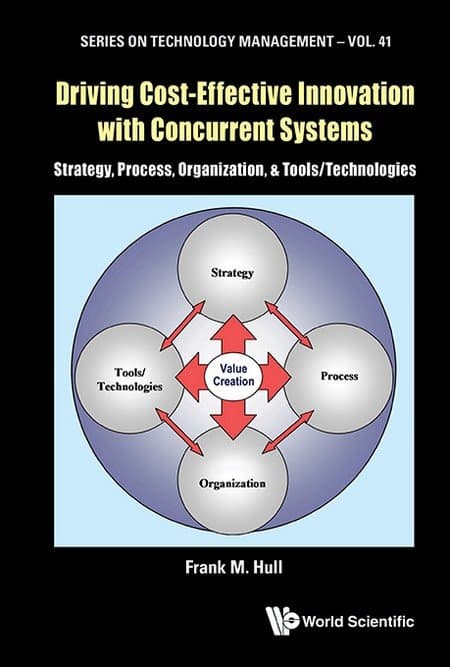
Driving Cost-Effective Innovation with Concurrent Systems
This book quantifies best practices for developing innovative products cost-effectively. Analyses of dozens of studies show how managing the work of people collaborating in parallel creates products faster, cheaper, and better in any organization. Concurrent systems deploy four kinds of practice simultaneously to synergistically achieve high performance: Strategy, Process, Organization, and Tools/Technologies (SPOT).
Appendices in every chapter enable stakeholders to benchmark their practices against Best-in-Class standards and identify gaps. A "Big Bang" index prioritizes best practices for improvement. A Composite Model™ algorithm enables designers of product development systems to further boost performance capabilities by combining complementary practices additively and synergistically. Managers and stakeholders collaborate in using these unique methods to build a "should be" vision of value development by closing gaps in their "as is" system to achieve diverse competitive advantages.
Case studies highlight how dozens of enterprises have successfully implemented SPOT practices to improve their performance. A transformation assurance process (TAP) provides tactics for champions to co-lead a five-step change journey: (1) Envisioning, (2) Diagnosing, (3) Assessing, (4) Implementing, and (5) Improving.